The Big Questions

How do galaxies evolve over cosmic time?
How do they build and use their gaseous reservoirs?

Where is the gas?

We probe the circumgalactic medium (CGM), which surrounds every galaxy out to 100 times the size of their stellar disks.

What are the gas properties?

We measure how much gas is there, what it is made of, and how it is moving.

How does the gas move in and around galaxies?

By comparing the gas properties to host galaxy properties, we determine whether and how the gas is accreting onto or outflowing from the galaxies.
Team News

What has the group been doing recently?

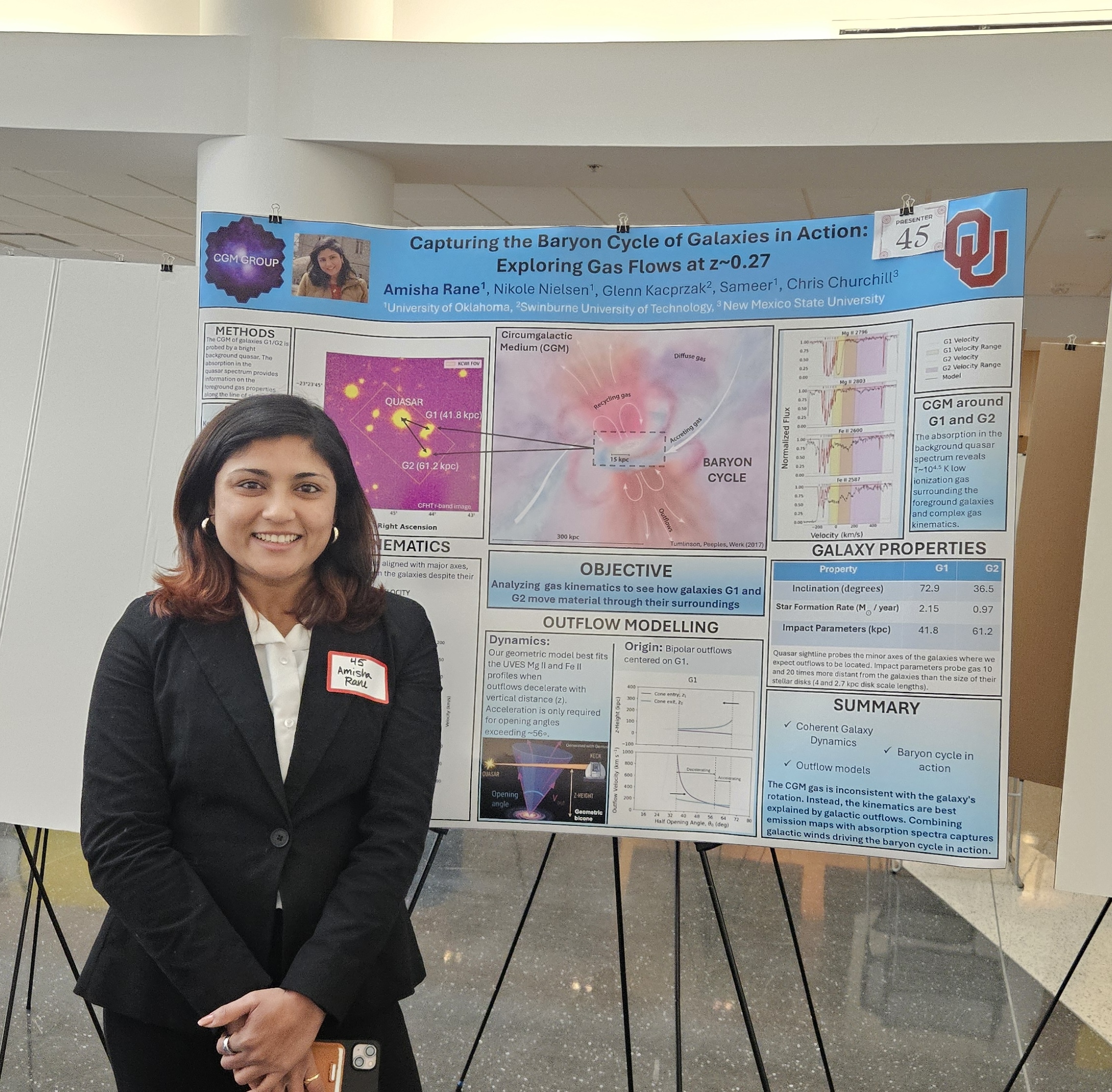
Amisha standing in front of her poster

Amisha Rane presented "Capturing the Baryon Cycle of Galaxies in Action: Exploring Gas Flows at z~0.27".

OU Graduate College Research Showcase

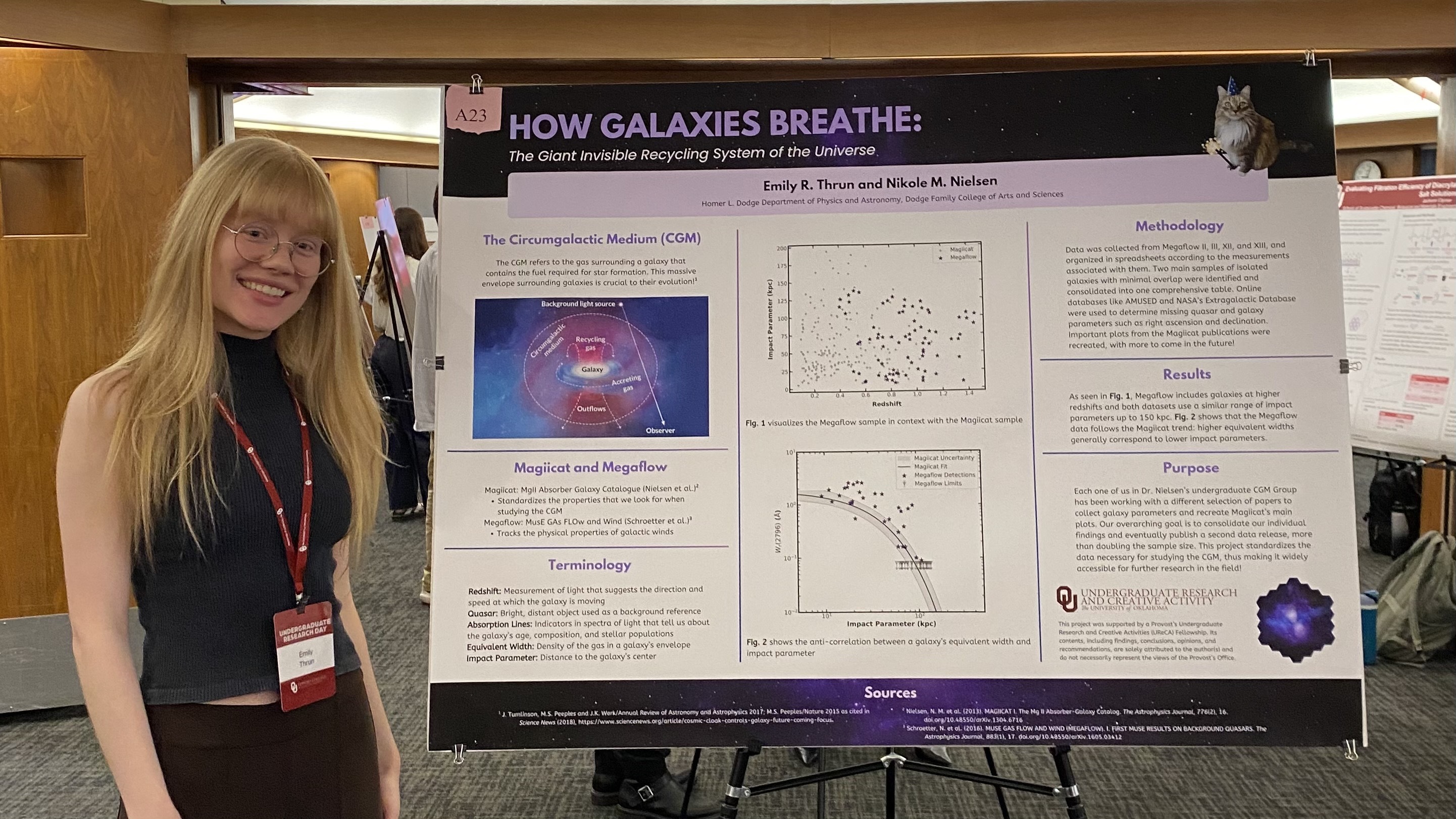
Several group members presented their research at the National Weather Center in February 2026.

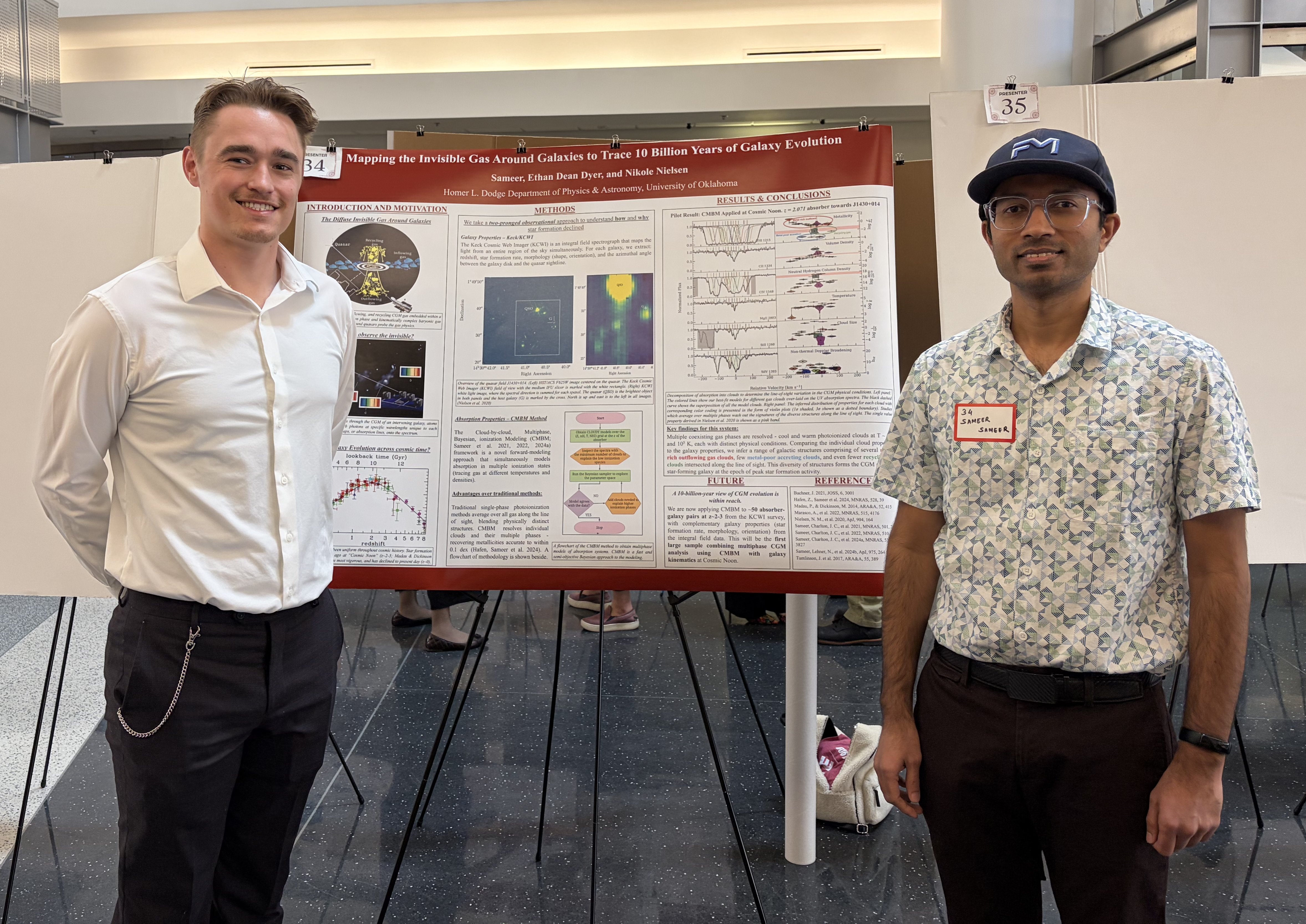
Ethan and Sameer standing in front of
			      their poster

Ethan Dyer and Sameer presented "Mapping the Invisible Gas Around Galaxies to Trace 10 Billion Years of Galaxy Evolution".

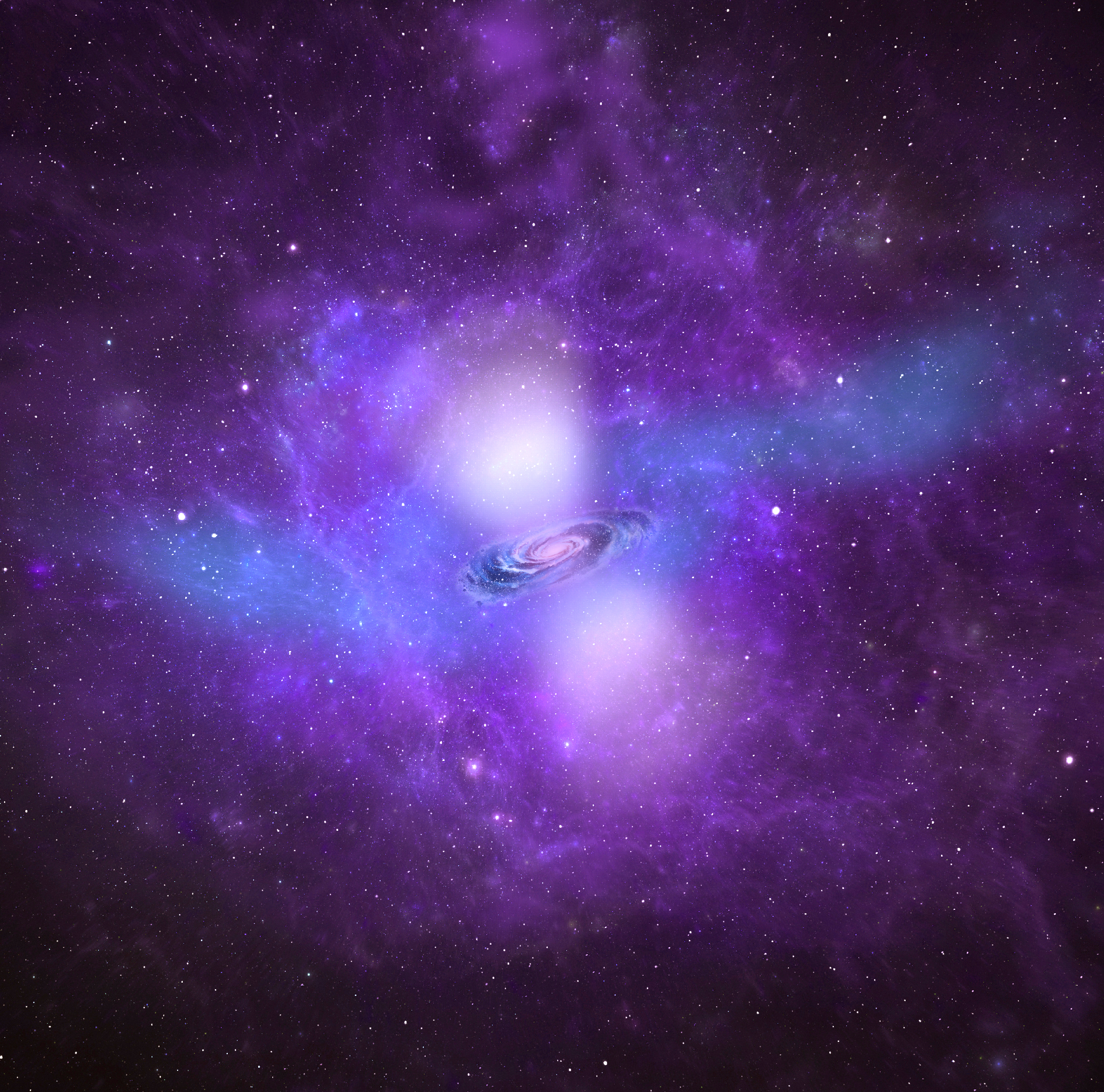
An artist's illustration of the CGM. The image outline
	  reflects the shape of the Keck mirror that observed the gas

Recent Papers and Media

We published an exciting paper in Nature Astronomy in September 2024, which mapped the CGM in emission around a nearly face-on starbursting galaxy (free access on arXiv.org). It collected quite a bit of media attention, including several tv/radio/podcast interviews with Dr Nielsen!

Cristy Roberts (ANU/ASTRO 3D) created the image (right) for us. A galaxy is located at the center, where outflowing (white), inflowing (blue), and other circumgalactic gas (purple) surrounds it.

A cat with a magic hat and magic wand

MAGIICAT: MgII Absorber–Galaxy Catalog

If you're looking for MAGIICAT data, you're in luck. It has migrated with us! Click on Trixie the MAGIICAT on the left for a shortcut.